I was reading an interesting article in the NYT, Can You Hear Yourself Think? It focuses on the idea of sound limiting, a way to limit the sounds around you so you can actually find peace and quiet in your mind during the days.
Although strict quarantine has lifted, most people are working and schooling at home this fall. There are still many limits on our time away from home and most of our time where we need to be focusing we are in noisy environments at home. The dog barks, the cat purrs, the neighbor is having construction done on their home, the kids are fighting as they school, your spouse is on a Zoom work meeting, the doorbell rings — and those are just the noises off the top of my head.
This article rightfully points out that Sound Proofing is super expensive and full of renovation costs. However, there is another idea where you can seek to limit the sounds around you. Perhaps there is a room in the house where it is designated as quiet. No noise no matter what. Noise cancelling headphones can take a lot of the noise away. Scheduling quiet hours for you and your family, designating a specific time to be quiet. Using inside voices together.
A good idea before all the madness at home begins this fall is to come up with a plan. Reflect on what made the home noisy this past spring and tackle these one at a time making a plan to reduce as much noise as possible for all members of your family. There will be noises that cannot be avoided, like the doorbell ringing, but some of this can be solved with a little planning.
Peace and quiet is often essential when it’s time to focus. Plan!
Times are tough – as they always are when it’s the topic of money. As such, financial experts and advisors tell people to create a budget and stick to it. Indeed, I hear a lot of people are tracking their money these days. One of the best ways people do this is by creating a spreadsheet. If you set it up right, the spreadsheet will show you all the money you have going in, going out, seeking to save, and more.
All there, in one neat place, your whole financial life can be seen and tracked. Sounds like a great idea on one hand, and, like most everything, it can also have a downside too.
Whenever I hear someone saying they are setting this up, it always sounds like a New Year’s Resolution – something to help break a bad pattern or to gain more control or to start a new leaf with money. It always seems to begin from the premise of improving one’s money circumstances. Something has gotten the person to feel that a spreadsheet will provide the solution needed to money ails.
On the surface, a spreadsheet tracking money can absolutely be something that is good and helpful in a person’s life. However, it is rarely the answer to stopping negative ways of interacting with money that reflects how we feel about ourselves. Instead, a spreadsheet can often act like a highlighter as to all that we do wrong, which can then lead into feeling bad about ourselves.
I would suggest asking yourself what is motivating you to track your money in such a concrete way? Is it to actually track your money or is it to highlight a part of yourself that you feel bad about already and this spreadsheet will serve as a tangible reminder of this “bad” part of you?
By asking yourself this question you can get a sense if tracking your money via spreadsheet is a healthy thing for you to undertake or is it just another tool to keep you tied to bad thoughts about yourself and others.
Be honest – as this may be the costliest decision of them all.
Doomscrolling. What a clever word for something many people are doing today.
Most of us were attached to our phones before the pandemic and political craziness of 2020 had taken hold. Yet, now something different is happening when we reach for our phones. It’s like the Temple of Doom.
We turn it on, head to our favorite social media sites, and go down the doom tunnel. A horrific article about the politics of the day to the ever-widening death toll from the pandemic to the economic havoc and mayhem — and that’s just the start. Another critical part of the doom scroll is reading all of the comments. I often think the comments grab us into doom more than the news itself.
All of a sudden, we are reading, scrolling, getting amped up, becoming anxious and depressed all at once — and it just keeps going. Compulsively we continue the doomscroll barely able to take a breath away from all we are reading. Someone told me he finally stops when there is no new doom to read. Seven hours in he takes leave of his phone!
This article in the Washington Post lays out what doomscrolling is and how to reign it in so you aren’t relying on the doom all day long. Some ideas in the article include changing your screen color to gray, spending limited amounts of time on-line in these ways, finding places on the Internet that offer the exact opposite of doom – like cute pictures of animals.
A few more ideas – actually purchase a real newspaper and read it. So old fashioned I know. Here though you can enjoy all of the news of the day without reading the comments of doom. Further, it provides space for your own good thinking about the article. Also, you are deciding what you will read in depth, skim, and skip altogether. Online reading is much more difficult to discern which is which for you on any given article as you may not be so interested, but you do want to hear what others think about it. Taking a more solo path can keep the doom at bay.
Also, choose your time of day for a good doomscroll. One where you are awake, active, and alert and not seeking rest and relaxation. Align yourself with the most energy you have to take it in and then leave plenty of time afterwards to let it all go. At night, keep your phone outside of your bedroom. Do not mindlessly reach for it, but keep in mind and value your sleep and rest over the doomscroll. Don’t worry all of the doom will be there waiting for you tomorrow.
We are wired to latch on to the bad and then worry to the nth degree about it all. We also our communal beings — we are drawn to know what someone else is thinking and then perhaps try that stance on and see if we feel the same way or not. However, this muddies the waters of knowing our own minds and trusting how we are thinking for ourselves. Reading without adopting how others are thinking about something is creating space for your own independent thinking. More important than ever these days.
Finally, doomscrolling is a time suck. It sucks you right down into the temple of doom and doesn’t let you go to actually live your life. There is less time for you. Sometimes I read the comments on news and its just on and on fighting and fighting and I think to myself do people really have so much time to fill arguing with strangers? Everyone is always saying how busy they are — is this what people are busy with? Or is doomscrolling a way to escape life that feels miserable? Sometimes I feel like attracts like. We feel our personal lives are doomed and so we seek out external doomscrolling to match this internal feeling.
Take a break and take stock. Life is lived in reality. Put the phone down, pick up a real paper, after a little bit of time, put the paper down, and go out and embrace your life. May it be full of Joy Living — hopefully steps — even miles — away form the doom.
A friend sent me an article about laughter during a pandemic. I think my friend knew I needed a lift and sent it along to me as a reminder to keep good humor during this uncertain time. Of course, I enthusiastically asked her to send me this article as I desperately needed to read it as I sometimes feel it is not OK to laugh or be light and funny during this time. Yet, it’s actually exactly what I need — i.e. to not take the whole thing so seriously and not get caught up in the abyss of the future that is more unknown than ever.
Are you keeping good humor these days? Are you the one sending around funny memes? Are you engaging in a deep belly laugh every now and again? Are you able to see the light side of the situation and make a joke? Or are you the person scouring when others engage in these ways? Whichever your reaction, my guess is that is says something about your mental state.
To be able to laugh is mentally healthy. Yes, even during a pandemic, it is important to give in to the lighter side of life and see that we can still hold on to this part of ourselves that is resilient, courageous, and has the ability to persevere in times of crisis and/or facing the unknown. Giving ourselves permission to give in and enjoy life during this time with good humor is really very important.
Have you noticed if nothing feels fun or funny or that people are annoying you who are embracing this these days? It may be an indicator of being very stressed, anxious, or depressed or a combination of all three states. One cannot embrace good humor – either our own or that of others – if we stay stuck in a serious, dire, anxious frame of mind. Living too far into the future or just looking around at reality in despair can truly lead to bad humor which can lead to low moods, physical ailments, or a general feeling of despair and inertia.
I want to encourage you to maintain some level of good humor during this time, especially if you feel anything but. Moving out of your comfort zone of being in misery, sadness, anxiousness, or hard-heartedness will not be easy, but I want you to open up and give it a try. See if some good humor can make it any better. And don’t do it for any great reason besides lifting your own spirits. Sometimes we feel guilty for putting ourselves above the collective situation and taking care of ourselves through something like laughter.
Good humor, laughter, optimism are all important components to being mentally healthy and resilient during this pandemic. Keep this in mind and laugh away!
It seems that these days all things old are new again. And this is true when it comes to puzzles. Remember the big jumbo 1000 piece puzzles you would do as a kid with other kids or your family. The pieces would be laid out on a large flat surface. There the puzzle pieces would sit beckoning to be put together.
It would often take hours to get it done over several days. Of course, starting at the corners, building the outside edge of the puzzle, and then filling it in — often by figuring out smaller puzzles that then fit into the big puzzle. It was quite something to see 1000 puzzle pieces be pieced together to find the picture on the front of the box.
With time on our hands and people in the house, puzzles offer us a place to ground ourselves in pieces that we can touch, creating a picture that is worth a 1000 pieces. There is something very satisfying to working a puzzle. I have seen puzzles in waiting rooms of therapy offices and often someone is in front of it working a piece of the puzzle. There are no apps, no screens, nothing bright and glitzy – just little pieces to put together. In this respect it feels really old fashioned.
It can also lead one to a sense of creativity as you are building picture of some sort as you work to solve the puzzle. Something that may be fun to do with your kids is to have them create their own puzzle. This doesn’t have to be 1000 pieces, but, using a thick piece of cardboard type paper, have them cut out different shapes that they seek to fit together to create their own picture. The can color in the picture once all of the blank pieces are pieced together. From there, pull it apart and solve their puzzle. Everyone in the family could do one and then hand it off to another family member to solve.
Puzzle time is back and in full force. I don’t think they ever went away — they just took our attention again when we had some time to solve them.
I read an interesting article the other day in the Washington Post regarding how the current COVID-19 pandemic is pushing America to the brink of a mental health crisis. I cannot even believe it has taken a severe public health crisis like this one for the media to begin to pick up on how difficult it is for Americans to find and receive quality mental health care today.
Sitting from the vantage point of a therapist, I know this to be true for many reasons. While most articles, like the one in the Post above, focus on access to mental health care, there is something else one has to first realize. Access to mental health care starts with clinicians who are in training to work in the field and serve people in need of mental health services.
It is an unfortunate truth and one not often discussed in the media that to do the work of a therapist, or, as the traditional license is called, a Licensed Mental Health Counselor, is a costly and time-consuming journey. One cannot clinically practice one-on-one therapy with individuals without holding a Master’s Degree in counseling, social work, or marriage and family work. This type of degree takes 3-5 years to complete with significant amounts of debt taken on to complete the degree, upwards and over $100,000.
Along this journey, graduate students in training are called to do an internship with a significant number of clinical hours and supervision time spent in order to earn one’s degree. Although a person may have at least 2-3 years of training experience in school, one’s internship is unpaid. People must find paid jobs as they juggle their internship demands.
This is where it strikes me that the mental health system is failing at its core. Community Mental Health Agencies that serve the poor and mentally unwell, a segment of the population that would have very little access to mental health services, are staffed with interns from graduate schools who are seeing these people for free. The core of the mental health services offered to thousands of Americans is valued at an intern level who earn nothing.
From there, graduate students leave school and are permitted their first license. Where I live it is an Associate’s license, which means you have the ability to see patients, but you must be supervised for a set amount of hours as you work toward full licensure, which is additional hours. Often Associate Mental Health Counselors use this period of time to take clinician positions in mental health agencies. Now they are no longer serving for free, but for $17 to $23 per hour. The average case load for a new Clinician is upwards to 100 clients. Then add in the math of $100,000 of student loan debt.
It is from this vantage point that I see our mental health system failing in America. From the start, when people seek to train to become a mental health clinician, no value is given to the skills that they are learning and employing to help people with their mental health needs. From weighting people down with student loan debt, to not providing any value to the intern seeing clients, and then providing a very low income to the new clinician with a caseload that no one can keep up with — not only are the clinicians burned out, but the system is overwrought with little to no support for people who need tremendous care.
What happens after one has completed her Associate’s license requirements and you are now a fully licensed therapist? Unfortunately, most clinicians leave Community Mental Health and set up their own private practice. Even if the clinician charges a reduced fee, it is often three times the amount one was earning at the mental health agencies. It is unfortunate that the very poor and mentally unwell people in America are left to be churned through by clinicians who are in some training phase of their career burning out without proper care, support, or caseload numbers.
Insurance also plays a roll in the inequity of the Mental Health system in America. Are you in network and, if you are, your patients may benefit, but the Clinician will likely make very little money for their services when all is said and done. If you are out of network, then the Clinician works with the patient to determine the fee. A patient may submit a receipt to their insurance company which may provide them with a portion of the fee they have paid. In this way, the patient has to decide what can they afford given the insurance company will only be reimbursing some of the full fee and that is often after deductibles are met.
All of this to say that when we look at the mental health crisis in America, we need to critically think about how we value our clinicians in training as well as how we value the services provided to the mentally unwell, especially those accessing care through the community mental health agencies. It begins with both parties being valued and supported in terms of money and care.
Until this happens, the system is on crumbling crutches which is going to further lead to the black hole of inadequate care, funding, and a lack of people to serve during crisis such as the one we are in currently.
Ever since this pandemic took over our lives I have been unable to sleep well and, when I do find sleep, I also find nightmares. Seriously, they are disturbing! Is there any way to alleviate these terrifying dreams. It’s gotten to the point where I don’t even want to fall asleep as I am scared of where my dreams will go — death, violence, isolation — this type of imagery is rampant for me. How to get good sleep during this time?
Sincerely, A Terrified Dreamer
This is so common. First, the inability to even get to sleep these days. This happens for a lot of reasons, including not maintaining one’s regular sleep regime, too many screens on too close to trying to sleep, worries and uncertainty on one’s mind — all leading to the inability to let go into an unconscious state and sleep. Which is critical to feeling rested and restored, bright and energetic to greet the next day.
Some tips on getting to sleep during this time include:
Maintain your normal sleep time — when you go to bed and when you get up
Turn off your screen well in advance of bedtime
A better activity is actually reading a real book or working on an old fashioned puzzle with a pencil – activities that can ground
If you have many worries on your mind, writing them down before sleep. In this way they become externalized. You are free to pick those worries back up again the very next morning, but writing them down and letting them breathe for the night outside of you may be helpful
Engage in a ritual that will relax you like a salt bath, gentle stretching or a meditation to calm one’s self.
Direct your dreams! (And this will lead into your nightmares) If there is something on your mind that you want to know about or an answer to, write it down on a piece of paper. Also, as you close your eyes, have this question on your mind and repeat it to yourself again and again. Often, this type of exercise is calling to your internal world to respond with an answer that is not conscious.
I mention this last idea of dream direction to help with the nightmares you are experiencing. All of us are carrying anxiety, worry, and, some of us, even terror over what is unfolding in our daily lives. We speak to it in a myriad of ways while we are awake during the day, and we are also speaking to it in our dreams. Deep down in the places we are not aware of, we are holding these worries and frights and they come out to haunt us in our nightmares.
I hear how terrifying they can be and that they are happening on a continual basis to the point that you do not want to even go to sleep. Engaging in steps #4 and #6 that I have noted above may help you set aside consciously the concerns you are feeling terrorized about as well as direct your mind to focus on something more interesting to you.
It will take some work to actively employ these strategies, but it may very well worth it to find not only sleep, but dreams that answer something on your mind, rather than terrorize you with worries. This is not just you — so many around the globe are being terrorized by their pandemic nightmares — you are not alone. I encourage you to take the steps above to help you sleep through this time of uncertainty that plagues us all.
Can you imagine the phenomena of Collective Dreaming? What does this even mean?
If you are curious about the whole idea, you are not alone. I wanted to know more myself when I saw a headline in the Seattle Times about the recent pandemic affecting our dreams on a global scale. If you have not been sleeping well and/or having nightmares, anxious dreams, worried dreams about loved ones, you are not alone.
Collectively, people across the globe are dreaming in these ways – together we are sharing similar dreams, but we are apart. Our dream state is now mirroring our wake state. There is even a term given for all of us dreaming during this time: COVID Dreamers. Are you one of the millions dreaming like this at night?
Now that we are on the subject, how are you sleeping generally? Are you able to fall asleep, i.e. let go into your unconscious world, are you awake until the wee hours vigilant that nothing should happen to you or your loved ones, are you remembering your dreams, when you wake do you feel well-rested? One creative idea is to bring your attention to these questions and check in to see how sleep is going for you.
From there, I recommend having a little journal beside your bed. This can be used in a myriad of ways that may prove helpful to you before, during, and after you sleep. Some ideas include:
Making a list of all that is on your mind that is making you worried or anxious. Taking time to write these things down can help you externalize them from yourself. Make note to tell yourself afterwards, they are all there safely written down. You will pick them up when you wake again.
To help promote intentional dreaming, ask yourself a question that is on your mind several times before you sleep. You can add this question to your notebook as well. Do this for several nights in a row and look for answers from your unconscious as you sleep.
If you happen to wake up to a dream, nightmare, or a thought on your mind, grab your notebook and write down what you recall immediately. It will most likely be lost within minutes of waking, so having the notebook and pen will make it convenient to record.
Same thing when you wake, whatever you recall from your dreams, how you feel, how you slept can all be recorded to track your sleep cycle and keep track of what is unfolding at night in your mind.
Sharing dreams, engaging dreams, looking up the meaning of dreams can all serve as fodder for what is going on with ourselves that we may not be aware of when we are awake. A mystery unfolds each night for ourselves to uncover and learn more about ourselves.
The idea of collective dreaming about this pandemic and the many ways it is a nightmare for all of us is a unique shared experience of our dream life. Sharing your dreams and inviting others to do the same with you can lead to new ideas and thoughts about self that can not only drive further understanding of self, but a creative way to tap into you.
A journal and pen or pencil is all you need. Also, the will and interest to know about yourself through dreaming.
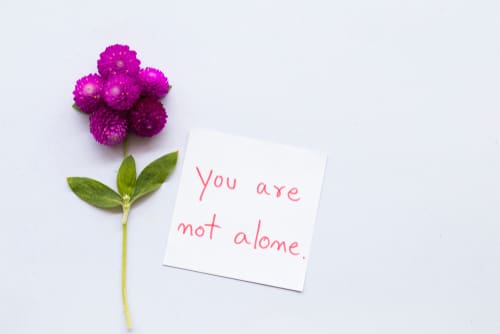
You are not alone! Say, what? Of course I am, you are thinking to yourself.
I was on my own last week when I heard the postman drop the mail through the slot. Ah! At least we get mail during this time of being at home. Mostly, I find my mail is made up of catalogues, bills, and junk, but every now and again a personal piece of mail is delivered and it totally delights me.
I am one who still writes real letters to friends and family near and far. I don’t do this to receive something in return, and so it is a delight to see that someone has returned the favor to me. I receive it with a grateful and open heart. These days, especially, where I spend the majority of my time at home, a personal missive means so much.
This day a friend had sent me a card with the message “You are not alone” on the front of the card, with hands reaching toward the center of the page where these words were written. Simple, yet powerful. I was feeling lonely or perhaps a little down with the whole situation. It has been awhile since I have seen my friends and family and, although there is Zoom, email, and Facebook, it is not the same as being together in person.
This was a powerful reminder that we are alone together these days. I think I even saw a cheesy commercial saying the same thing. We are apart, but together. All of us are at home, alone, and yet together. Just being reminded of this in such a tangible way gave me a hope and lift in my spirits.
It is important to remember that you are not alone at this moment in time. We are in our homes, doing our own things, and, in many ways, alone. Yet, each day we are a part of a shared collective experience of this across the world. People are thinking of others, people are still caring, people are still people with all the needs we have to be known, felt cared for, and be told we are not alone.
You are not alone. Not today. Not ever. Reach out and let someone you know know.
Do you have a feeling of being forgotten these days?
During this extraordinary time, all of us are spending our days at home. If you are single or living alone for another reason, it is easy to not only feel lonely, but there may also be a sharp edge to this feeling — one that is laced with feeling you are forgotten by others. It is one thing to be lonely, quite another to have a felt sense of being forgotten by your family and friends.
This felt sense of being forgotten by those you care for can land one into a depression thinking that no one remembers you exist and are curious enough to reach out, check in, and hear how you are doing. There is never an excuse for people to not remember, but in the fast-paced world that we normally move in we are left with little space to touch base with those we are thinking of on a regular basis. We become too caught up in our own selves.
But what is happening when all we have is time on our hands? Still, no calls come in to you with people checking in on you. I believe this situation is extraordinary in and of itself and has thrown people off kilter. I am not sure they are forgetting you, but rather are caught up with their own whirlwind of emotions as they face this crisis that they fine there is no extra room for others.
What if you are noticing you are the one always reaching out and thinking of others and checking in? Yet, the same is not returned to you in kind. This may also lead to a felt sense of feeling forgotten by others. Unless you are reaching and doing, nothing is happening. How empty!
How can you move out of the feeling of being alone that is laced with feeling forgotten and into feeling connected and remembered by others? Here are some ideas:
Set up a standing check in time with others and take turns reaching out to one another.
Use your voice and let people know how you are feeling so that people can move in toward you rather than you moving away from them.
In your family, set up a chart of Birthdays and anniversaries and other important dates and share it. Make a commitment to remembering one another.
Reach out and ask a friend to call you
Observe who is making gestures to share time with you. Perhaps there are people doing this, but you are not tuned in to these people as you are focused on someone else remembering you. Keep track of who is present and available to you and show up to this person and be present.
It is a terrible feeling to feel lonely and it is even more complex when there is an element of feeling forgotten. Recognize the feeling and move toward caring for yourself, especially during these extraordinary times. When a friend recently confided how alone and lonely they felt, I made the effort to text this person and sent some real mail. Her sharing her very real feelings with me allowed me to directly remember her and hold her up.
Be open to surprise! Others may do the same for you.