
Dear Therapist: Tired of Watching Shows

Tired of Watching Shows

Dear Therapist:

I am tired of watching shows during this time at home. I never thought I would admit this as there is so much good TV and content to watch out there, but hour after hour and I actually feel really tired and lethargic. I used to watch a few hours per week, now it’s a few hours morning and night. Are there any other alternatives to watching shows during this stay-at-home time?

Sincerely, Boob Tubed Out

It seems like this would be the perfect time to sit and watch shows, shows, and more shows. There is so much content out there right now and so much of it is exceptional. It seems like it would be so easy to sit there on the couch hour after hour and watch the shows without limit. It feels almost counter-intuitive to think watching shows is exhausting. Yet, it is.

If you are interested in watching stuff, but not shows, you are in luck as there are many, many options:

  1. Street Walks
  2. Opera
  3. National Theater
  4. Art Museums
  5. Historic Homes
  6. Broadway Shows

This is a time to armchair travel your way to great cities, museums, and cultural events in ways that we never could before. It is something completely different and a true delight. Yes, you are seated, but your mind is free to take in something new to feed your mind, interests, and senses.

After this, go out for a walk and let your mind be full of the wander you took – it can also serve as inspiration as you plan your next trip.

Limiting the time you use to watch shows is necessary. Give that hour or two to yourself when you really don’t want to do anything else except watch a TV show or movie. We all have those moments, but it is not something that can be sustained for days at a time.

Just say no to passive watching and yes to activities that have been taken on-line.

Celebrations At Home

Celebrations at Home
Celebrating at Home?

As life continues at home for most of us, life and all of its celebrations have not stopped. Birthdays and anniversaries are always in full swing throughout the year — these special personal days come along no matter what is going on in the world. Given the pandemic times we are in, many people are not going to have the celebration they were expecting this year.

As I am a planner, I always have something good planned for my friends, family and myself as their and my special days rolls around. Oh my goodness, all of those plans have been taken off the table in no uncertain terms. As I realized this as the weeks marched toward these special dates, I had to take some time to feel this disappointment of not being able to enjoy the plans that I had carefully made to delight my loved ones. Instead of brushing it off, I faced my sadness over the loss of my special plans for this year. Being able to sit with my sad feelings for some time allowed me to take the next step.

To make the most of what I could do to celebrate. For Birthdays, I could send cards or flowers, I could call, I could order a Birthday cake, hey how about take-out since it’s so special these days to not cook, find a movie and watch it together, take a walk with the loved one I live with, and, most importantly, be present to the person.

Everything wasn’t exactly how I thought it would go, but letting go of my expectations allowed me to be in the moment and see what unfolded that was new and different. Although these were not the celebrations I had planned, being present to the celebrations that unfolded was not only interesting, but fun.

If you are going to be having some celebrations at home soon, here are my top tips:

  1. Give yourself time to process, grieve, and let go of what you may have planned and were looking forward to.
  2. Make the most of what you can do — baking a homemade cake, buying a card at the grocery store, setting up a Zoom party, taking a walk, ordering takeout, and anything else that you may have around your home to celebrate – i.e. bang pots and pans.
  3. Be open to what unfolds without expectations — the unexpected phone call or card in the mail perhaps.
  4. Relax.
  5. Be in the moment. This is most certainly a unique one.

Whatever you do, indeed mark the celebrations at home. It is important to make a big deal of our loved ones and special events. Even though we are all at home, this is not a year to “pass,” but rather to have a celebration that you will remember when you think back to these pandemic times.

What Day Is It?

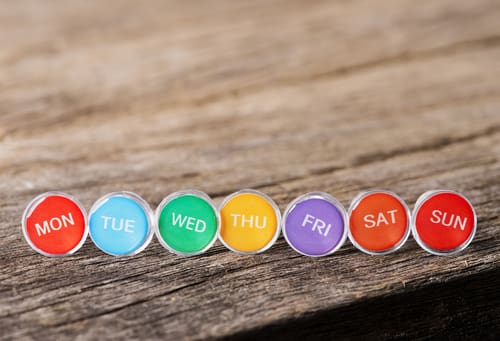
What Day Is It Buttons
Have you lost track of the days of the week?

What day is it?

Has this question been on your mind lately? It’s no surprise given the weeks without end under a “shelter in place” order that the majority of America and the world is following for the time being. We mark the days and the weeks by certain rhythms, such as going to work, the children going to school, the weekend with an often errand-filled Saturday, date night Saturday, and a relaxing Sunday.

Goodbye schedule, Goodbye rhythms. We are in new territory indeed!

I was reading an article in the New York Times discussing the phenomenon of losing track of the days. The article points to more stress, anxiety, and uncertainty as several factors combined with a lack of rhythms to mark and differentiate time for ourselves. After all, time is made up by man. Man decided to carve out a five-day work week and two days at the end of each week to rest and relax. He also carved out the working hours of 9 to 5.

All of us pretty much abide by these artificial designations because it’s always been this way and we conduct our lives accordingly based on the day of the week and the time of day. What happens when none of that matters or makes sense?

Some of us are working from home so that gives some sense of how a day is supposed to be spent — but even then there is no space differentiation from working at home to being at work. We are just at home round the clock, i.e. living, working, keeping kids busy, and more. The days of the week are blending together and so it would be easy to work on a Saturday as it is a Tuesday.

What if you aren’t working? Then this is time out of time for you. Your routine has been completely disrupted. There is literally is no where to go and nothing to do outside. You are called to shelter in place day after day with no change. Time often doesn’t feel like that – it speeds up, it slows down, it tells us where we need to be, it keeps track of the hours we work and sleep, and how long it takes to cook something.

Time is still making up each of our days, but what does it matter when we struggle to see or feel any of it right now? Here are a few tips to help yourself keep track of the days and time that makes it up:

  1. If you aren’t keeping track of the days or you are finding it difficult, don’t fight against it. Give in and see what it is like to feel time differently, if you feel it at all. This is a unique situation and surely one where you can learn about you and your family.
  2. If it is important to track time, then orientate yourself to the day of the week upon waking up, “Today is Monday.”
  3. Once you have grasped the day of the week, approach it as you would that type of day in regular times. Is it Monday? Get up and begin your week. Is it Saturday? Perhaps the day you go out and grocery shop? Is it a Friday night, perhaps a date night?
  4. To shake it up a bit, once you remember the day, turn it on its head and do the opposite of what you are normally supposed to do on that day. As an example, on a Wednesday, spend the day watching shows. Just experiment with turning the normal routine of time on its head.
  5. Remember time has not changed — there are still 24 hours in the day, making up 7 days in a week, making up the 12 thirty or thirty-one day months, making up the 352 days in the year. How we experience this time is what has changed. Notice and observe yourself moving through this time and perhaps journaling about how it feels the same and different.

What day is it? I am often wondering it myself these days. Know you are not alone in feeling lost in how we have made up our systems of time. Lost is not a failure, but rather a place to explore and find unique ways to cope and turn time on its head for a split second of eternity.

Dear Therapist: No Job No More

No Jobs No More

Dear Therapist:

I am out of work like 16 million other Americans at this time. I don’t feel alone, but I am scared. I don’t know how long this will last and whether will there even be a job to return to when this mess is over? Nothing is certain, except the bills I have to pay. Any suggestions on how to handle this type of stress? I am glad to be one of many, but I am scared to death wondering if I will make it?

Sincerely, Frightened Along With Everyone Else

It is a terribly bleak situation. The numbers have gone through the roof for people and small businesses applying for government benefits that will sustain them during this time of crisis. That’s the first place one must put her energy – filing for unemployment, applying for small business loans and grants, and waiting on your check from the government to help ease the pain of today.

However, I also hear your concern over the unknown facts of when will this even be over and when it is over will there be your old job to return to or will that job be gone? Those are two huge uncertain elements for everyone at this time. We cannot yet know when the orders to “shelter in place” will be officially lifted, then what businesses will reopen, and how the public responds to business being back to normal, if in fact this is the plan that is happening.

The unknowns are the worst in a situation like this and that drives anxiety. Collectively, I think American society is on edge not only out of concern for our health, but also the financial cost of the crisis that is impacting so many people like yourself.

Grounding yourself in the moment with what you do know is one of the best courses of action for now. You and I both don’t know the answers to some of these major questions. We can focus on what we don’t know or we can be in the moment right now and take care of what needs to be taken care of in the here and now. It may be difficult, but just navigating the applications alone for assistance will take up a large chunk of time. Not only will you feel like you are moving forward by completing those tasks, your energy will also be focused.

Breathing in four counts through your nose and four counts out of your mouth four to five times can also aid in slowing down and grounding in the here and now. Although this is a terribly anxious time, we can find ways to soothe and calm our worries in the here and now and I encourage you to do so.

Do You Have that Forgotten Feeling?

Feeling forgotten like wilted flowers

Do you have a feeling of being forgotten these days?

During this extraordinary time, all of us are spending our days at home. If you are single or living alone for another reason, it is easy to not only feel lonely, but there may also be a sharp edge to this feeling — one that is laced with feeling you are forgotten by others. It is one thing to be lonely, quite another to have a felt sense of being forgotten by your family and friends.

This felt sense of being forgotten by those you care for can land one into a depression thinking that no one remembers you exist and are curious enough to reach out, check in, and hear how you are doing. There is never an excuse for people to not remember, but in the fast-paced world that we normally move in we are left with little space to touch base with those we are thinking of on a regular basis. We become too caught up in our own selves.

But what is happening when all we have is time on our hands? Still, no calls come in to you with people checking in on you. I believe this situation is extraordinary in and of itself and has thrown people off kilter. I am not sure they are forgetting you, but rather are caught up with their own whirlwind of emotions as they face this crisis that they fine there is no extra room for others.

What if you are noticing you are the one always reaching out and thinking of others and checking in? Yet, the same is not returned to you in kind. This may also lead to a felt sense of feeling forgotten by others. Unless you are reaching and doing, nothing is happening. How empty!

How can you move out of the feeling of being alone that is laced with feeling forgotten and into feeling connected and remembered by others? Here are some ideas:

  1. Set up a standing check in time with others and take turns reaching out to one another.
  2. Use your voice and let people know how you are feeling so that people can move in toward you rather than you moving away from them.
  3. In your family, set up a chart of Birthdays and anniversaries and other important dates and share it. Make a commitment to remembering one another.
  4. Reach out and ask a friend to call you
  5. Observe who is making gestures to share time with you. Perhaps there are people doing this, but you are not tuned in to these people as you are focused on someone else remembering you. Keep track of who is present and available to you and show up to this person and be present.

It is a terrible feeling to feel lonely and it is even more complex when there is an element of feeling forgotten. Recognize the feeling and move toward caring for yourself, especially during these extraordinary times. When a friend recently confided how alone and lonely they felt, I made the effort to text this person and sent some real mail. Her sharing her very real feelings with me allowed me to directly remember her and hold her up.

Be open to surprise! Others may do the same for you.

Dear Therapist: Running Out of Patience

Running out of patience and time
Running out of Patience?

Dear Therapist,

I am at the start of Month #2 of Shelter in Place in my town. My heart fell to the floor when the order was recently extended another whole month. At first, it was novel to work at home, bond with my family, and have more time to myself without the running around, but now I am running out of patience! How do I keep it together at this drags on — and on?

Sincerely, Running out of Patience

Ah! What a feeling! What a situation!

I think many people are in states where the people have been sheltering in place for weeks by now and are about to enter into not week, but month two of the situation. I hear that you, at first, appreciated the change in your life that this order originally had on your life, but it’s now worn off and you want to get back to your life as usual.

I am sure you are not alone with what you are feeling. There is definitely a desire to want to get back to work, to errands, to sports, to events, to coffee with friends, to networking chats, and everything else that took us out into the public to connect, produce, enjoy, and live each day. Being grounded as a kid was never fun, and now the entire world is in this state.

One thing, we know our neighbors and everyone else is in the same boat. One way to grow patience is to recognize you are not alone. Everyone in your community is in the same place and most people are probably wishing this could all be over yesterday. Knowing you are in good company can help ease the feelings.

Next, recognize that staying in is for your safety and the safety of others. It is literally the staying put that is saving lives. How can it be? Something so simple — stay home and save lives. Yet, it is so foreign and strange to stay in the majority of the time for weeks on end. Still, holding in mind the purpose that this is for something much greater than yourself may help you tolerate these days.

I would also suggest creating a list of all that you want to do once this time is over. I know it helps me to write these items down – both mundane and fanciful items – to keep my hopes up that this time will end and I will be prepared to move on to things that have been put on indefinite hold during this time. It is important to have a list in mind as to what you are looking forward to when this is over.

Finally, try to be present to this moment. It is an unusual, strange time, but one that will not last forever. Take it in as fully as possible. Use the time to learn about yourself, the ones you live with, and what about this time is realy good and what poses challenges. There is much to be learned by slowing down and observing one’s self in this unusual space.

How do we grow patience? There is no magic answer, but, in time, it will all pass. Find ways to structure the days, find meaning within, and be present to what is unfolding in the now to not get too ahead of yourself, but to find the good in here and now. Today.

Shelter in Place Productivity

Shelter in Place Productivity
Do You Feel Pressure to be Productive?

Under the Shelter in Place Order, do you feel pressure to be productive?

I read an interesting article in the New York Times last week regarding productivity. Most Americans believe in the ethos of being productive during each of their days, and this time is no different. You may be working from home, but with no commute time and orders to stay in round the clock, there is more time in our lives to be productive. Yet, this article challenges the idea of productivity and asks Americans to stop trying to be productive.

I will admit, I have heard many stories of self-condemnation during this time from people wishing they were getting up earlier, working on their creative projects more, learning a new hobby, exercising more, cooking up gourmet food, and more. The idea of sleeping in, watching TV, reading for pleasure, napping, and/or doing absolutely nothing is not something people are aspiring to right now, but perhaps we should be.

Must this “shelter in place” time be one where we find new ways to criticize ourselves by not meeting American productivity standards? It is important during this time where we have been grounded in our homes to give credence to this strange situation. Just living under our circumstances is taking more energy and time. No it is not time that is producing anything, but it does take energy. This may be why we are sleeping more or a little slow during our days or can’t get as much done as we would like.

We are also challenged to be communicating with others constantly through technology. Although it is wonderful to live in this age with technology at our fingertips, it is tiring to be meeting others over the screen. It is not the easiest to begin with and then to have to go through meeting after meeting – both personal and professional – via the computer, it tires us in ways we are not tracking, but just assuming that it is the same as before.

The many ways our lives have changed is taking more time to process and live into each day. Before you lay on yourself productivity goals, perhaps check in and see what has changed and how you may be caring for yourself during these times. Most likely, these ways will not be about productivity, but rather slowing down and doing less. Being able to turn down the volume on our productivity is a gift we can give ourselves, especially if we can drop the judgement that we aren’t doing enough.

You are enough and are doing enough in this moment. There is a wonderful argument to be made for not being productive at this moment in time. Take up this challenge and do less and take good care.

Creativity Burst: Dyeing Easter Eggs

Dyeing Eggs
A Spring Tradition

Happy Spring. For many people, this is Easter week in the Christian church. It feels a little strange this year given most are unable to gather for worship services or a big Easter Brunch. I had plans to celebrate, but the holiday and the week will be far less grand as I continue — like you – to “shelter in place.”

However, we can still keep some of our traditions that are creative, colorful, and fun. For me, this has to be dyeing Easter eggs for the holiday. Whether as a child or an adult, I always look forward to the PAAS Kit that gives you the little tablets that get all fizzy in vinegar, the clear crayon to write names on the eggs, and stickers and other fun decorative elements for the eggs. As an adult, dyeing Easter eggs takes me back to my childhood and fun, simple, family memories that I appreciate keeping alive for myself all these many years later.

Of course, there are many ways to dye Easter eggs that have nothing to do with PAAS. I remember the year that I lived in Australia and went to the grocery store at Easter time to find my PAAS kit. After scouring the store for what seemed like forever, I ended up asking a store manager where the kit was. He looked at me like I had lost my mind. I was in complete disbelief to learn he had never even heard of the PAAS kit. Now, Australia celebrates Easter in a big way, how could they not dye eggs there? “Oh,” he answered, “you want to color your eggs? Check out the food coloring in aisle 8!” That’s right coloring eggs is old school there.

So, I know there are many ways to dye Easter eggs that are much more natural and innovative. In fact, here are ideas for how to make your colors naturally. During these times, when we have a lot more time on our hands, it may be the year to go natural.

For me, I do find this project to be a creative one. To take regular eggs, hardboil them, and color them using a commercial product like PAAS or natural vegetables to make your own dyes, this is a wonderful project to welcome in spring and do something fun to celebrate the season.

Of course, the next thing to do is to hide the eggs and hunt for them. Always fun for the kids, but even adults may have fun hiding and go seeking eggs this year. If this hunt is for adults, make sure to be creative with your hiding places.

Sometimes creativity is sparked by going “old school” and doing something that you did when you were much younger to reconnect with that earlier time in life that was full of simple pleasures. This would be a great week to dye some eggs, hide some eggs, and get in touch with your inner child and how she wants a spark of creativity in her world.

Do You Feel Alone or Lonely?

Woman alone or lonely
Are you alone or lonely?

Do you feel alone or lonely these days?

Well, for many people we are going either into Day 1, Week 1, Week 4 or more under a “Shelter in Place” order by our Governors across the United States and for many abroad where the entire countries in Europe and beyond are also indoors — staying put to slow down a virus and save lives. For now, we are all in this together — but on our own. Meaning, you are basically with who you live with — no more, no less.

This may mean a houseful of people, a couple and a child, a couple, or one person on her own. Regardless of who you are at home with these days, it can be difficult. Even if you are an introvert, it may be easier to be home in isolation with yourself or others, but when it is not a choice it can be difficult for you as well.

Thus begs the question in these days whether we feel alone or lonely. Sometimes we can feel both.

To be alone is not necessarily a bad state to be in. How often do we yearn for time to be alone with our thoughts or to spend time exactly as we want to spend it without concern for others. Being alone opens a gateway to engaging with one’s self without any distractions. To be alone can be wonderful.

To be lonely is an entirely different matter. Loneliness can make one feel empty and unwanted and may also lead to depression. Being alone is not a time to recharge, but rather time to move into a low place of feeling about one’s self. In these times of “sheltering in place” many people are not only alone, but are also feeling lonely. And even if you are not alone as you are living with your family, you can feel utterly lonely.

Normally one of the antidotes to loneliness is to reach out and be with others. However, in our current circumstances that is near impossible. So, how do we combat loneliness during these extraordinary times?

  1. Pose the question to yourself — are you alone, lonely or both?
  2. If you are alone, but not feeling lonely, relish this time. Follow your bliss at home and enjoy the time to recharge alone and/or with your family.
  3. If you are feeling lonely, whether alone or living with others, this is a natural feeling when so much of life has changed and there is forced time to be at home. Ask yourself if you are feeling empty and unwanted? What is this time bringing up for you? Use the feeling of loneliness to learn more about yourself.
  4. From there, think about what you can do to bring yourself out of your lonely state. Although we are in our homes, we are encouraged to go outside and take walks in nature which may help you place yourself in the larger world. Indulge in taking care of yourself at a very high level indulging in things that make you feel good, perhaps a salt bath or a vigorous workout, a favorite show or book to tune into, or a favorite song that will move you to dance.
  5. Of course, connection is key as we are humans and desire to connect with one another. If you are feeling lonely, even as you are living with your family, make time to connect with them in meaningful ways. If you are alone, make video call dates with family and friends. I have also heard of on-line classes taking place where people are making things together or working out together. You may want to look into activities that can be done together on-line. Make sure to keep connecting each day.

To be alone is not synonymous with feeling lonely. During this time of “shelter in place” check in with yourself often to see how you are feeling and make sure to move to take care of yourself during this time. You may be alone or feel alone, but you can combat the feeling of loneliness if you continue to check in and ask yourself what you need in the here and now moment.

My hope is each of us will use this time to nurture ourselves — learning about how we react to such times internally and what we move to do externally to care well for ourselves.

Dear Therapist: Virtual Happy Hour Etiquette

Virtual Happy Hour

Dear Therapist:

Well, I’m at home most days all day long and the only way I connect with others is through technology. Most people are using Zoom, which I appreciate as I can see tons of my colleagues and friends all at one time. However, during casual Zoom gatherings, everyone is talking at one time or people take turns talking and all eyes are on that person. I know it’s a virtual Happy Hour, but it feels weird. Any advice on how to make casual Zoom gatherings easier for everyone to participate and feel heard?

Sincerely, Zooming Away

Sounds like you are a whole lot like me these days where most of our social connection outside of our immediate family is via technology. Any chance I get, I appreciate hopping on to a Zoom meeting for work or for fun to connect with others today. Recently, I too have noticed that work meetings seem to run smoother than casual meet ups on Zoom.

I think this is because when we are meeting for work or a class, the host has several rules set up that everyone must follow. The host asks the participants to “mute” themselves to clear out background noise, as well as use the “raise hand” feature when you have something to say so that people can take turns participating.

However, when you are thinking about a casual Zoom happy hour or other type of meetup, the last thing you want to do is employ rules. Yet, we may need to in order to connect in the best way possible. Sticking with the “mute” button is a good thing to use whether business or personal – the background noise cut out really helps.

Regarding people talking over one another is difficult, but perhaps you should ease up. Think about meeting up people at a crowded bar. It is loud, people are all talking at once, and it is difficult to keep up. However, I think this is something we are all missing right now, i.e. a crowd of people chatting together. Only thing is given the medium, people want to hear what people are saying. In the bar, what often happens is small groups of conversation begin to form and while everyone is together different conversations are happening at the same time. This is almost impossible on a Zoom meeting.

Which then leads to the awkwardness you are experiencing. One person is speaking, everyone listens and is focused on that one person, and then everyone chimes in one at a time about what the person has said. It definitely puts that person in the “hot seat” of attention and also nothing else can be spoken about because the attention is going to only one person. And then how to move on, especially if the person has shared something really difficult?

Ah! What to do? I don’t think there is much that can be done. This medium is odd for casual gatherings. Accepting this and moving into what it does offer, i.e. a big group of people we can see at once in a time when we hardly see anyone may be worth the difficulty of easy flow connection.

Be forgiving, find energy from the field of people who have come together, and don’t take any of it too seriously. The point is to connect. Let the rest go!