
Home School and Kids’ Autonomy

School and Kids' Autonomy

A friend of mine who has two school-aged children was mentioning the recent stress around having her children attend school at home during this pandemic. She and her husband are not ones who were ever in the homeschool camp, and I believe their children are following the on-line curriculum set forth, but something is becoming apparent the longer children are studying at home.

The fact that children not only go to school to learn and socialize, but also to gain autonomy over their selves and their lives as they move through the days and years of their school education. Parents play an important role of support to their kids during this time, but it is about recognizing how they are learning to become self-sufficient, gain confidence, and be able to navigate a world both professionally and personally that is not at home.

Now with children learning at home, parents are now a part and parcel of their kids’ education that does not take these needs into account very easily. First off, the children are at home with their parents. Whatever the patterns of interaction are set at that home base are now going to play out 24/7 with your children. Perhaps at school they have less fear and more confidence than they do at home. Now, all of a sudden, those character traits are no longer around.

Second, children are responsible for their school work and their learning, but this is aided by teachers teaching them who are not our relatives. Our kids have different relationships to their teachers than their parents. It may be that a parent discards certain subjects that a child loves and received affirmation for from his teacher. With that relationship gone, a child is now surrounded by the parent’s judgments on what they should or should not be focused on learning, which robs the child of his autonomy over his interests.

You may also notice that your children moved independently without you during school, but are more dependent on you at home. This is OK when the kids are sitting in both spaces most days, but now, at home, have they reverted to being completely dependent on Mom and Dad for everything. If so, how to encourage them to break away from this pattern, even as the parents are involved in the learning process.

Wow! a kids’ autonomy over himself and his school career can become seriously compromised during this home schooling period of time. Even noticing this tension is an excellent first step in removing one’s self from being so involved that children cannot be themselves as they learn. The parent must first see that their children are not exercising their autonomy to be able to make meaningful changes that will be helpful to their kids.

Once it is recognized, making sure to step back and build in space for them to find their way without you. Yes, you may need to solve tech challenges or answer questions that they are struggling with, but keeping distance and boundaries from your student’s on-line learning process would also be a good idea.

Also, if you are noticing a lack of independence, a reliance on you to solve their school problems, or you becoming too invested in their school work with judgment, it is time to put space in between you and your children’s learning process. Take a breath and break. Remember most of the time, you are not at school with them observing anything. Instead of trying to control what you are observing, give more space and sit back and notice what is unfolding. This is an unusual time that allows for you to observe your children in a new setting.

Noticing, observing, doing less, controlling less are all keys to helping kids hold on to and continue to develop their autonomy during this challenging time of going to school at home with Mom and Dad as central participants in the learning these days.


Best Books to Read During Quarantine

Books to Read
What’s on Your Reading List?

So, what are the best books to read during quarantine?

The answer is simple: whatever you are drawn to — and perhaps, with more time on your hands to read, this is the moment to break out and read in a new genre. Say you love reading literary fiction. This may be the moment to try a mystery or something funny to change up what you are reading. Or you could just pick out a bunch of books that you read in the genre you love and dive in.

I always appreciate reading the Book Review section of the New York Times to inspire my reading choices, especially these days. I am not only sending books off to others that I think they may enjoy, but also downloading Kindle books that catch my interest, both in my field and just for fun. I am trying to bring in the new to my days that keep on and on one after the other in quarantine. A book takes me away from my world and envelopes me in another

Also, I find reading is different to watching a show. My mind gets to imagine the world that the author paints for me in my own way. It is not completely prescribed and so my imagination comes into play more when I read. And when I find an author who writes so well that I can’t put the book down, that is just so satisfying in a way that watching something does not deliver for me.

There are many lists of books to read during this quarantine time. Here are some:

  1. People Magazine
  2. Time Magazine
  3. Refinery 29

And there are many, many more lists like these that encourage you to read and give your mind a break from the quarantine many of us are still living in across the world. This also may be the time to revisit all of those books you were supposed to read in high school and college. You know, the classics! You may want to revisit the authors of the past to hear their tales of wisdom, even the master Shakespeare may be calling your name.

Read! Take time to read for fun, pleasure, to escape, to relax. Then share with me — what are you reading?

Creativity Burst: Puzzle Time

Puzzle Time
Pandemic Puzzle Time!

Pandemic Puzzle Time!

It seems that these days all things old are new again. And this is true when it comes to puzzles. Remember the big jumbo 1000 piece puzzles you would do as a kid with other kids or your family. The pieces would be laid out on a large flat surface. There the puzzle pieces would sit beckoning to be put together.

It would often take hours to get it done over several days. Of course, starting at the corners, building the outside edge of the puzzle, and then filling it in — often by figuring out smaller puzzles that then fit into the big puzzle. It was quite something to see 1000 puzzle pieces be pieced together to find the picture on the front of the box.

With time on our hands and people in the house, puzzles offer us a place to ground ourselves in pieces that we can touch, creating a picture that is worth a 1000 pieces. There is something very satisfying to working a puzzle. I have seen puzzles in waiting rooms of therapy offices and often someone is in front of it working a piece of the puzzle. There are no apps, no screens, nothing bright and glitzy – just little pieces to put together. In this respect it feels really old fashioned.

It can also lead one to a sense of creativity as you are building picture of some sort as you work to solve the puzzle. Something that may be fun to do with your kids is to have them create their own puzzle. This doesn’t have to be 1000 pieces, but, using a thick piece of cardboard type paper, have them cut out different shapes that they seek to fit together to create their own picture. The can color in the picture once all of the blank pieces are pieced together. From there, pull it apart and solve their puzzle. Everyone in the family could do one and then hand it off to another family member to solve.

Puzzle time is back and in full force. I don’t think they ever went away — they just took our attention again when we had some time to solve them.

Mental Health Crisis in America

Mental Health Crisis in America
Mental Health Crisis Brews in America

I read an interesting article the other day in the Washington Post regarding how the current COVID-19 pandemic is pushing America to the brink of a mental health crisis. I cannot even believe it has taken a severe public health crisis like this one for the media to begin to pick up on how difficult it is for Americans to find and receive quality mental health care today.

Sitting from the vantage point of a therapist, I know this to be true for many reasons. While most articles, like the one in the Post above, focus on access to mental health care, there is something else one has to first realize. Access to mental health care starts with clinicians who are in training to work in the field and serve people in need of mental health services.

It is an unfortunate truth and one not often discussed in the media that to do the work of a therapist, or, as the traditional license is called, a Licensed Mental Health Counselor, is a costly and time-consuming journey. One cannot clinically practice one-on-one therapy with individuals without holding a Master’s Degree in counseling, social work, or marriage and family work. This type of degree takes 3-5 years to complete with significant amounts of debt taken on to complete the degree, upwards and over $100,000.

Along this journey, graduate students in training are called to do an internship with a significant number of clinical hours and supervision time spent in order to earn one’s degree. Although a person may have at least 2-3 years of training experience in school, one’s internship is unpaid. People must find paid jobs as they juggle their internship demands.

This is where it strikes me that the mental health system is failing at its core. Community Mental Health Agencies that serve the poor and mentally unwell, a segment of the population that would have very little access to mental health services, are staffed with interns from graduate schools who are seeing these people for free. The core of the mental health services offered to thousands of Americans is valued at an intern level who earn nothing.

From there, graduate students leave school and are permitted their first license. Where I live it is an Associate’s license, which means you have the ability to see patients, but you must be supervised for a set amount of hours as you work toward full licensure, which is additional hours. Often Associate Mental Health Counselors use this period of time to take clinician positions in mental health agencies. Now they are no longer serving for free, but for $17 to $23 per hour. The average case load for a new Clinician is upwards to 100 clients. Then add in the math of $100,000 of student loan debt.

It is from this vantage point that I see our mental health system failing in America. From the start, when people seek to train to become a mental health clinician, no value is given to the skills that they are learning and employing to help people with their mental health needs. From weighting people down with student loan debt, to not providing any value to the intern seeing clients, and then providing a very low income to the new clinician with a caseload that no one can keep up with — not only are the clinicians burned out, but the system is overwrought with little to no support for people who need tremendous care.

What happens after one has completed her Associate’s license requirements and you are now a fully licensed therapist? Unfortunately, most clinicians leave Community Mental Health and set up their own private practice. Even if the clinician charges a reduced fee, it is often three times the amount one was earning at the mental health agencies. It is unfortunate that the very poor and mentally unwell people in America are left to be churned through by clinicians who are in some training phase of their career burning out without proper care, support, or caseload numbers.

Insurance also plays a roll in the inequity of the Mental Health system in America. Are you in network and, if you are, your patients may benefit, but the Clinician will likely make very little money for their services when all is said and done. If you are out of network, then the Clinician works with the patient to determine the fee. A patient may submit a receipt to their insurance company which may provide them with a portion of the fee they have paid. In this way, the patient has to decide what can they afford given the insurance company will only be reimbursing some of the full fee and that is often after deductibles are met.

All of this to say that when we look at the mental health crisis in America, we need to critically think about how we value our clinicians in training as well as how we value the services provided to the mentally unwell, especially those accessing care through the community mental health agencies. It begins with both parties being valued and supported in terms of money and care.

Until this happens, the system is on crumbling crutches which is going to further lead to the black hole of inadequate care, funding, and a lack of people to serve during crisis such as the one we are in currently.

Dear Therapist: Pandemic Nightmares

Pandemic Nightmares
Pandemic Nightmares Are Real!

Dear Therapist,

Ever since this pandemic took over our lives I have been unable to sleep well and, when I do find sleep, I also find nightmares. Seriously, they are disturbing! Is there any way to alleviate these terrifying dreams. It’s gotten to the point where I don’t even want to fall asleep as I am scared of where my dreams will go — death, violence, isolation — this type of imagery is rampant for me. How to get good sleep during this time?

Sincerely, A Terrified Dreamer

This is so common. First, the inability to even get to sleep these days. This happens for a lot of reasons, including not maintaining one’s regular sleep regime, too many screens on too close to trying to sleep, worries and uncertainty on one’s mind — all leading to the inability to let go into an unconscious state and sleep. Which is critical to feeling rested and restored, bright and energetic to greet the next day.

Some tips on getting to sleep during this time include:

  1. Maintain your normal sleep time — when you go to bed and when you get up
  2. Turn off your screen well in advance of bedtime
  3. A better activity is actually reading a real book or working on an old fashioned puzzle with a pencil – activities that can ground
  4. If you have many worries on your mind, writing them down before sleep. In this way they become externalized. You are free to pick those worries back up again the very next morning, but writing them down and letting them breathe for the night outside of you may be helpful
  5. Engage in a ritual that will relax you like a salt bath, gentle stretching or a meditation to calm one’s self.
  6. Direct your dreams! (And this will lead into your nightmares) If there is something on your mind that you want to know about or an answer to, write it down on a piece of paper. Also, as you close your eyes, have this question on your mind and repeat it to yourself again and again. Often, this type of exercise is calling to your internal world to respond with an answer that is not conscious.

I mention this last idea of dream direction to help with the nightmares you are experiencing. All of us are carrying anxiety, worry, and, some of us, even terror over what is unfolding in our daily lives. We speak to it in a myriad of ways while we are awake during the day, and we are also speaking to it in our dreams. Deep down in the places we are not aware of, we are holding these worries and frights and they come out to haunt us in our nightmares.

I hear how terrifying they can be and that they are happening on a continual basis to the point that you do not want to even go to sleep. Engaging in steps #4 and #6 that I have noted above may help you set aside consciously the concerns you are feeling terrorized about as well as direct your mind to focus on something more interesting to you.

It will take some work to actively employ these strategies, but it may very well worth it to find not only sleep, but dreams that answer something on your mind, rather than terrorize you with worries. This is not just you — so many around the globe are being terrorized by their pandemic nightmares — you are not alone. I encourage you to take the steps above to help you sleep through this time of uncertainty that plagues us all.

Creativity Burst: Collective Dreaming

Woman Dreaming
Are you capturing your dreams?

Can you imagine the phenomena of Collective Dreaming? What does this even mean?

If you are curious about the whole idea, you are not alone. I wanted to know more myself when I saw a headline in the Seattle Times about the recent pandemic affecting our dreams on a global scale. If you have not been sleeping well and/or having nightmares, anxious dreams, worried dreams about loved ones, you are not alone.

Collectively, people across the globe are dreaming in these ways – together we are sharing similar dreams, but we are apart. Our dream state is now mirroring our wake state. There is even a term given for all of us dreaming during this time: COVID Dreamers. Are you one of the millions dreaming like this at night?

Now that we are on the subject, how are you sleeping generally? Are you able to fall asleep, i.e. let go into your unconscious world, are you awake until the wee hours vigilant that nothing should happen to you or your loved ones, are you remembering your dreams, when you wake do you feel well-rested? One creative idea is to bring your attention to these questions and check in to see how sleep is going for you.

From there, I recommend having a little journal beside your bed. This can be used in a myriad of ways that may prove helpful to you before, during, and after you sleep. Some ideas include:

  1. Making a list of all that is on your mind that is making you worried or anxious. Taking time to write these things down can help you externalize them from yourself. Make note to tell yourself afterwards, they are all there safely written down. You will pick them up when you wake again.
  2. To help promote intentional dreaming, ask yourself a question that is on your mind several times before you sleep. You can add this question to your notebook as well. Do this for several nights in a row and look for answers from your unconscious as you sleep.
  3. If you happen to wake up to a dream, nightmare, or a thought on your mind, grab your notebook and write down what you recall immediately. It will most likely be lost within minutes of waking, so having the notebook and pen will make it convenient to record.
  4. Same thing when you wake, whatever you recall from your dreams, how you feel, how you slept can all be recorded to track your sleep cycle and keep track of what is unfolding at night in your mind.

Sharing dreams, engaging dreams, looking up the meaning of dreams can all serve as fodder for what is going on with ourselves that we may not be aware of when we are awake. A mystery unfolds each night for ourselves to uncover and learn more about ourselves.

The idea of collective dreaming about this pandemic and the many ways it is a nightmare for all of us is a unique shared experience of our dream life. Sharing your dreams and inviting others to do the same with you can lead to new ideas and thoughts about self that can not only drive further understanding of self, but a creative way to tap into you.

A journal and pen or pencil is all you need. Also, the will and interest to know about yourself through dreaming.

Dear Therapist: Career Coach v. Career Counselor

Career Coach Sign

Dear Therapist:

With everything going on right now, I am reevaluating my career. I feel this time at home may be a good time to think about creating a new career path for myself as I’ve been pretty miserable for awhile now. I could use some help with the process and am thinking I would like to work with a Career Coach or a Career Counselor. What’s the difference? Does it even matter?

Sincerely, Looking for Career Direction

This is an excellent question because as you allude to in your question, is there even a difference? Actually there is and it’s a good moment to know what it is so you can decide the type of person who can best help you through your career transition.

Are you looking for help in exploring various industries and thinking about your strengths and weaknesses across each one? Are you interested in creating new materials to help you find a new job, i.e. a cover letter and resume? Are you thinking about ways to hone your social media profiles to support your job search? If any of these steps resonate with you, I believe you are in need of a Career Coach.

A Career Coach works with you to discern what your next job and/or career path will be, either in the same industry or a whole different one. The focus will be on who you are, your strengths and weaknesses, and creating a sense of what you want to bring to the materials you need to create to make yourself not only fit, but also stand out from all the other applicants. Concrete career steps like these are the focus of a Career Coach.

Alternatively, are you feeling stuck in your same job? Do you hate your job, know you really need to move on, but just can’t seem to take the steps? Feelings of anxiety, depression, stuckness, and internalized criticism that are hampering your progress in your career is a place to work with a Career Counselor. It is not about the job process itself, but rather what is happening to keep you somewhere you don’t want to be.

Career Counselors work with you to think about thought patterns, messages, and ideas that your have been given over the course of your lifetime that are operating to keep you immobilized professionally. By looking at these core beliefs you hold and starting to name and then unravel them are keys to becoming unstuck and moving forward to a career you are happy with. Career counseling is often a much more internal process, whereas the coaching process is about the action toward a new job.

Which space are you in? This delineation should clarify the difference for you, as well as provide you with a few questions to ask yourself in order to decide what you need. For more information on Career Counseling, what it is, how it can be approached, and feelings that are associated with difficulty in this area, click here.

Pandemic Drinking

Pandemic Drinking
How much are you drinking during this pandemic?

Pandemic Drinking! Yes, this has become a real thing.

I happened on an article in the New York Times and it is titled: New Yorkers Want Cheap Wine and Lots of It. This headline caught my attention and had me reading about the way people are buying wine, the demand for cheap bottles, and how they are turning to drinking to help cope with COVID-19. We all have heard of the very popular Zoom Happy Hours with our friends these days. I suppose we need to be stocked for these occasions.

Are we drinking more than usual? Are you drinking more than usual? These are good questions to ask ourselves in the midst of this stressful time. Observing and noticing our drinking habits to see if and how they may have changed would provide some insight as to how we are coping with the crisis.

If I were to take this article at face value, people have not stopped drinking, but rather there is a clear demand for alcohol, just bottles that are cheaper given how often they are buying it and the lack of money to indulge in fine, expensive bottles of alcohol.

I remember a Professor of mine back in school once said to her class, “At the end of the day, if you are enjoying a glass of wine, enjoy it. However, if you are reaching for a second glass, that is the time to be asking yourself why? What is going on?” I always thought that was a good thing for me to keep in mind whenever I was pouring myself a glass of wine during the end of my normal days.

Now, do we even need to ask ourselves such a question? Isn’t it obvious why, if we are reaching for a second glass, the reason? The stress of these days, the anxiety over the uncertainty of the situation, the boredom of not having much to do, the desire to escape our reality or, at least, to take the edge off of the days. There are many obvious reasons people are drinking more. It could also be you were always reaching for more drinks than you felt comfortable with, but the pandemic is now the perfect excuse to make you feel better about your habit.

Whatever the reason, alcohol, as it has always been, is around if we want it. Reaching for a glass or even two may not be a problem at all as long as we are conscience of what we are doing and noticing/observing how we are feeling as we do so. Even during these stressful times, it is still important to stay attuned to one’s self and what we are and are not doing to care for ourselves. In this way, we can stay present to the action of drinking.

Also, if you are reaching for the wine, make it an enjoyable, mindful experience. Smell the fermented grapes, take notice of the beautiful color, and really taste it when you take the drink. Bringing a mindful approach to how you drink may not only show you down, but offer a moment to really relish what you are drinking and not just drinking to drink. How about a Zoom Wine Tasting to experience mindful drinking with your friends?

Alcohol is playing its role during this pandemic. Notice, observe, and be present to how you are using it to stay in touch with yourself and how best to care for you. Cheers!

Creativity Burst: Backyard Photography

Backyard Photography Humingbird
Are you a budding photographer?

Backyard Photography? Say what?

These days, while we all are sheltering in place, provides a time to take our interests and elevate them. How to do this when our world, that is our supposed oyster, is within the confines of our home and yard can be a challenge — until you give it a little more thought.

If you like to take photos on your trips – even with only your phone – this is a time to dig in and get creative with your photography skills at home. Luckily this time is happening during spring when everything is coming into full bloom. The flowers are blooming, the leaves on the trees are bursting forth, the birds are at their feeders, the bunnies are hopping, and more.

A simple walk around your neighborhood will bring this all alive for you, but so too will a walk around your own yard. Don’t forget your camera when you head out the next time to take it in. Here is where a creative challenge can arise for you that may help you look at the world in a way that you really see the season in action.

Head out to your bird feeder and wait for the birds and then try to capture them eating or drinking the nectar. See a bunny in someone’s yard – or your own- can you focus on his cotton tail and capture it? How about the blossoms – can you get up close and pick up the texture of the petals via your photography skills? Even an amateur can take time right now to try a new angle, a new lens, a new way of taking a photo – this experimentation can lead to a burst forth of creative energy.

Even better? Involve the entire family and encourage them to take photos on your walks and around your home. Then, afterwards, review the photos together to see how people saw their subjects and why they decided to capture the flower, bunny, or bird in the way they did. Even better? Print off your photos and create a collage of them as a memory to hold on to — how you and your family saw the world during this unique time.

I am not a professional photographer by any means, but when I travel, I love to capture the scenes I take in as I go along. This is a reminder that we can capture them at home as well. There is magic and life happening where we call home. Opening our minds and grabbing our cameras are the two keys we need for this creative exercise.

You Are Not Alone

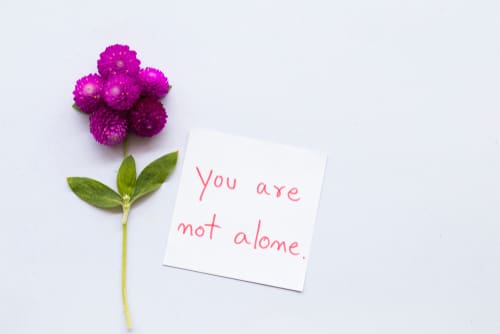
You are not alone card

You are not alone! Say, what? Of course I am, you are thinking to yourself.

I was on my own last week when I heard the postman drop the mail through the slot. Ah! At least we get mail during this time of being at home. Mostly, I find my mail is made up of catalogues, bills, and junk, but every now and again a personal piece of mail is delivered and it totally delights me.

I am one who still writes real letters to friends and family near and far. I don’t do this to receive something in return, and so it is a delight to see that someone has returned the favor to me. I receive it with a grateful and open heart. These days, especially, where I spend the majority of my time at home, a personal missive means so much.

This day a friend had sent me a card with the message “You are not alone” on the front of the card, with hands reaching toward the center of the page where these words were written. Simple, yet powerful. I was feeling lonely or perhaps a little down with the whole situation. It has been awhile since I have seen my friends and family and, although there is Zoom, email, and Facebook, it is not the same as being together in person.

This was a powerful reminder that we are alone together these days. I think I even saw a cheesy commercial saying the same thing. We are apart, but together. All of us are at home, alone, and yet together. Just being reminded of this in such a tangible way gave me a hope and lift in my spirits.

It is important to remember that you are not alone at this moment in time. We are in our homes, doing our own things, and, in many ways, alone. Yet, each day we are a part of a shared collective experience of this across the world. People are thinking of others, people are still caring, people are still people with all the needs we have to be known, felt cared for, and be told we are not alone.

You are not alone. Not today. Not ever. Reach out and let someone you know know.